
Contract Dynasty Feature
AdvancedRFA Tenders: market price for your expiring players
Restricted free agency brings real GM-style decisions to dynasty fantasy football. Tender an expiring player, set a salary and rookie pick compensation, then watch the league bid. Match the winning offer to keep them, or decline and collect rookie draft picks. Available now in contract dynasty leagues on League Tycoon.
The Concept
What restricted free agency adds to your league
In contract dynasty, when a player's contract expires, the team has two options: franchise tag them, or let them walk into the free agent pool. (Extensions have to be signed earlier, during the player's final contract year, not after the contract has ended.) RFA adds a third path for players who finished the last year of an initial contract: put a tender on them, set the price, and let the league test whether anyone is willing to pay more.
The original team holds the leverage. They control the tender level, which sets both the salary and the compensation. They get the right to match the winning offer, so a player is never lost without their consent. But pricing the tender correctly is an art. Tender too low, and the compensation you collect is weak if a rival pries the player away. Tender too high, and you may overpay for a player no one bids on.
For the rest of the league, RFA tenders create a real shopping window. The trade-off: you bid the salary and you ship draft pick compensation if the original team declines to match. That cost has to be priced into every bid.
Walkthrough
How RFA Tenders work, step by step
A five-phase flow that combines a tender offer, a public auction, and a right-to-match decision.
Pick a tender level
When a player on your roster has finished the last year of an initial contract (rookie, FA draft, or free agent pickup), they are automatically RFA-eligible. You open the Tender Offer screen and choose a level. Each level pairs a 1-year salary with rookie pick compensation. Higher levels cost more salary but lock in better rookie pick compensation if another team beats your offer.
In the example, Level 2 is selected. The salary is $30 for one year, and if another team makes a winning bid that you decline to match, you collect a 2027 2nd round rookie pick from the bidding team. Level 1 raises the salary to $40 but locks in a 1st round pick instead, which is a stronger deterrent to outside bids.
Once you sign the tender, the platform adds a 1-year contract at the tender salary and queues the player for the RFA auction.
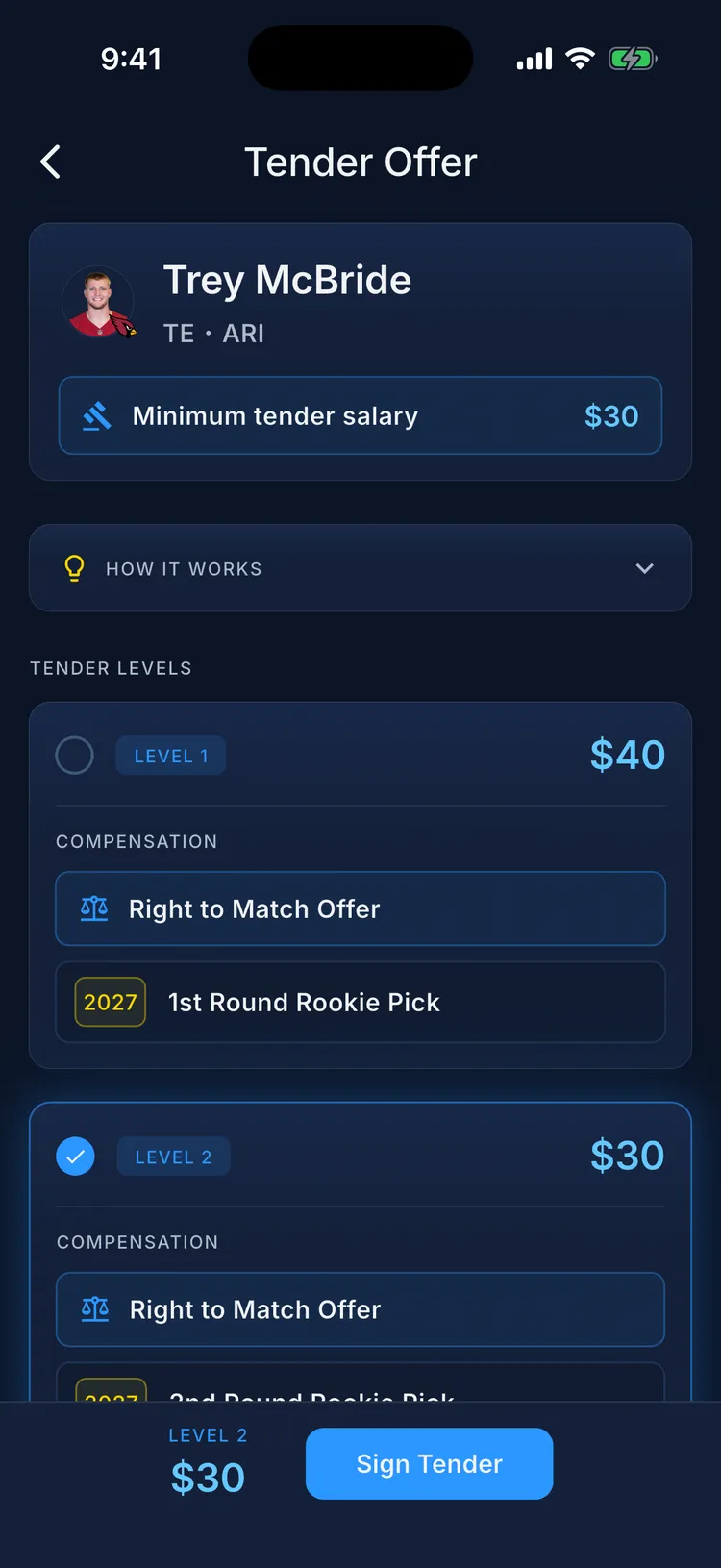
Tender Offer screen. Each level pairs a salary with a draft pick compensation package.
The RFA auction opens after rollover
The auction does not start the moment a tender is signed. After the league rolls over to the new season, the tender window closes and every tendered player is queued for the RFA auction. The auction runs in the new season before the rookie draft. It is a contract bidding draft, configurable as live or slow. Contract bidding is required so that multi-year offers can be matched during the auction.
Other teams must factor in compensation when bidding. They are not just spending cap dollars and contract slots, they are also putting up the rookie picks tied to the tender level. A Level 1 tender with a 1st round comp can scare off most teams. A Level 4 tender with no comp is an open market.
A rival bids, you decide
After the bidding on a tendered player ends, the draft enters a Right to Match phase for that player. The high offer is shown clearly: salary, contract length, and the bidding team. You match the exact terms and keep the player, or decline and trigger the compensation transfer. Once you decide, the auction moves on.
In the example, Team 2 bid $26 per year for 3 years. The original team must decide: match the 3-year, $26 deal and keep the player, or decline and collect the 2nd round pick that Team 2 owes per the Level 2 tender.
The decision is real. Matching means committing real cap dollars over multiple years. Declining means losing the player but adding a 2nd round rookie pick to your draft capital.
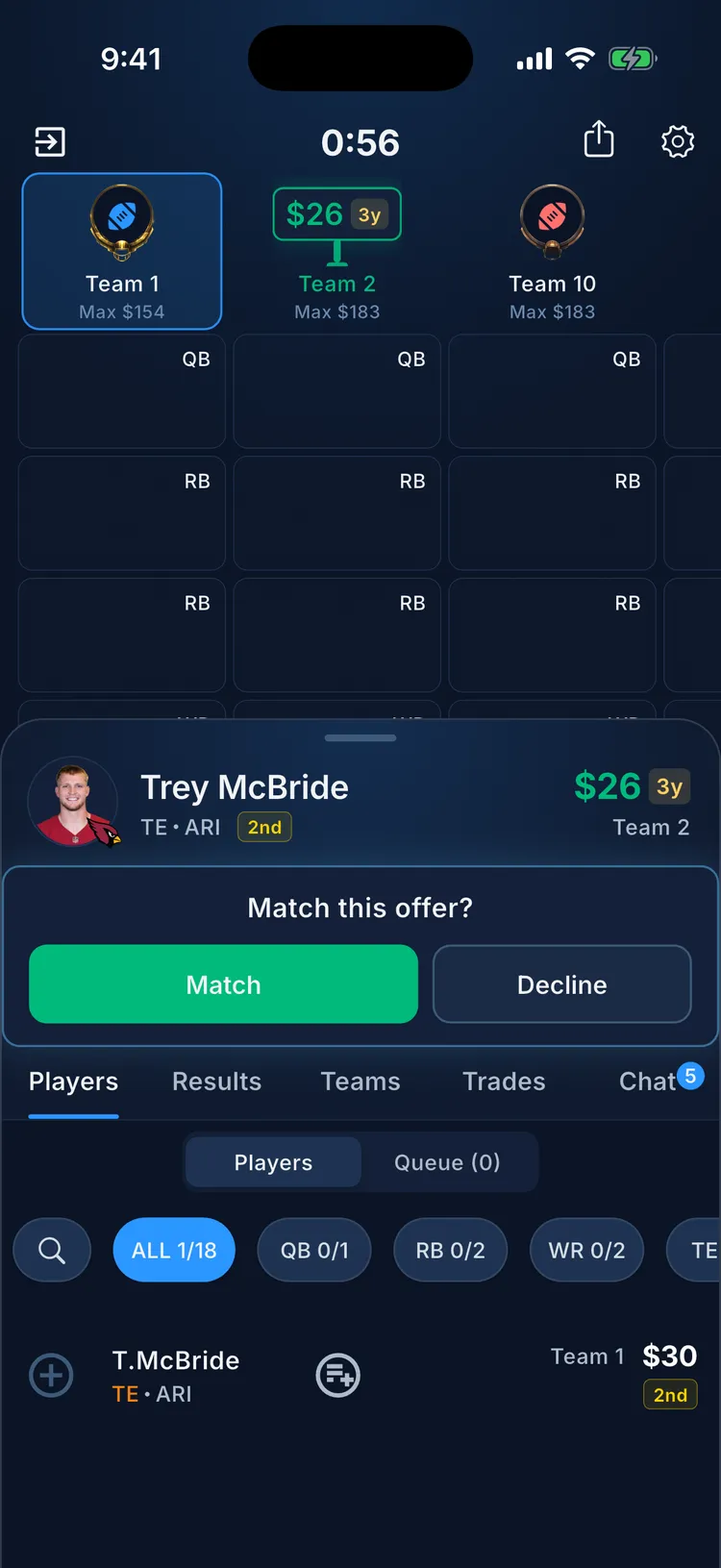
Right to Match. Accept the offer to keep the player, or decline and collect compensation picks.
Compensation transfers automatically
If you decline to match, the platform handles the rest. The player moves to the winning bidder under their offered contract. The compensation rookie picks transfer from the bidding team to your team for the upcoming rookie draft. Cap space, contract slots, and pick ownership all update in one transaction. There is no commissioner email chain, no manual ledger, no ambiguity about which pick goes where.
If you match, the player stays on your roster at the matched contract terms. Multi-year matches consume your team's contract slot allocations for the relevant length and lock the player's salary across all years.
Auction closes, rookie draft begins
Once every RFA decision is resolved, the auction closes and the rookie draft can start. Compensation picks are now in the correct hands, RFA contracts are signed at their final terms, and every team knows exactly what their roster and picks look like heading into the rest of the offseason.
Eligibility & Timing
Who can be tendered, and when it happens
Automatic eligibility
A player is RFA-eligible the offseason after they complete the last year of an initial contract. Initial contracts are:
- •Rookie contracts
- •FA Draft contracts
- •Free Agent contracts (in-season pickups)
Each player's contract type is shown on their contract card. Players whose initial contract has been extended or franchise tagged do not get a second RFA window.
RFA window
The RFA tender window runs from the end of the regular season through the league's season rollover, the same window as the franchise tag. Tenders sign during this window. After the league rolls over to the new season, the RFA auction runs before the rookie draft.
The rookie draft cannot start until the RFA Auction is complete, so compensation picks are still available to transfer when a team declines to match.
Weigh The Risk
Compensation is fixed by the level you choose
This is the core risk-reward of RFA: your compensation is determined by the tender level you select, not by the size of the winning bid. Even if the offer comes in much higher than your tender, you only receive the compensation tied to the level you signed.
Higher levels have higher salaries but give better compensation if you don't match the offer. Lower levels could save salary, but you risk losing a player for less compensation. Tender too low on a player who turns out to be a steal, and a 4th-round comp pick will feel small. Tender too high on a player no one wants, and you are stuck paying a premium 1-year salary.
The skill in RFA is not just identifying which players are worth keeping. It is identifying which level prices the player accurately. The market will tell you whether you were right.
Tender Levels
A salary for every appetite, a comp pick for every level
Commissioners configure as many tender levels as the league wants. A typical setup has three or four levels with declining salaries and weakening compensation.
| Tender level | Salary | Compensation if declined |
|---|---|---|
| Level 1 | Highest | Right to match + 1st round rookie pick |
| Level 2 | Higher | Right to match + 2nd round rookie pick |
| Level 3 | Lower | Right to match + 3rd round rookie pick |
| Level 4 | Lowest | Right to match only |
Commissioners configure the salaries and compensation picks for each level. If the player's stable salary increase comes in higher than the Level 1 setting, the Level 1 tender's starting price adjusts up to that stable increase amount, so a tender at the top level is always offerable.
Every level grants the right to match, regardless of compensation. The original team is never forced to lose a player without their consent.
Strategy
What makes RFA Tenders different
Price discovery on retained players
An extension or franchise tag locks a price you set. RFA forces a market test. If no one bids, you learn the player was overvalued. If multiple teams bid, you learn the player was a steal at your tender.
Bidders pay in picks, not just dollars
Outside teams are not just spending cap dollars and contract slots. They also ship the compensation rookie picks if the original team declines to match. That second cost reshapes which players are worth chasing.
Asymmetric leverage
The original team has the final say. The bidder is committing real assets, and the original team can match the deal at the bidder's terms. This is a classic NFL mechanic, not a redraft pattern grafted onto dynasty.
Rebuilders get an exit ramp
Teams not ready to commit to a player can decline and collect picks. Tendering at Level 1 then declining is a legitimate way to convert a fading veteran into draft capital, with the platform handling the transfer.
Contenders can pry players loose
If a rebuilding team underprices a player on a low tender, contenders can target them. Pay the salary, ship the picks, and the player is yours. RFA is one of the few avenues to acquire a player from another team without negotiating a trade.
Multi-year bidding is allowed
Outside teams can offer 1-year through 5-year contracts (per league settings). Long-term offers can lock in talent at a fixed cap hit. The original team must match the exact length, which means they accept the cap commitment in full if they keep the player.
Commissioner Control
Configurable for the league you actually run
Every part of RFA is in the commissioner's hands. You decide how many tender levels exist, what each level's salary is, and which rookie picks each level transfers.
The platform enforces the rules you set. Cap impact is calculated automatically. Pick ownership updates the moment a decision is made. Compensation availability is checked on the bidding side, so a team that does not own the required picks cannot place a bid on that player in the first place.
Tip: keep simultaneous nominations lower for slow RFA auctions
Compensation picks tie up against active high bids during the auction. With a high simultaneous-nomination cap, teams can quickly have their rookie picks tied up and be unable to bid.
For commissioners migrating an existing dynasty league or designing a brand new contract dynasty league, the contract league rules reference covers RFA in the broader context of franchise tags, extensions, and the full season timeline.
Is RFA right for your league?
An advanced mechanic, an optional one
Great fit for
- •Veteran contract leagues looking for more offseason action
- •Leagues that want NFL-realistic restricted free agency mechanics
- •Owners who enjoy market-based price discovery on their roster
- •Leagues willing to spend a bit more time on offseason decisions
Maybe skip if
- •Your league wants the simplest possible offseason flow
- •Members can't commit to multi-day decision windows
- •You haven't played a contract dynasty season yet (start there first)
RFA is fully optional. Commissioners can run contract dynasty without it and add it in a later season once the league is comfortable with the basics.
RFA Tenders FAQ
What is an RFA tender in fantasy football?
Who is eligible for an RFA tender?
When does the RFA window open and close?
How do tender levels work?
Does compensation scale with the winning bid?
Are there minimums on which tender level I can choose?
What is the right to match?
Are RFA tender offers always 1-year contracts?
What happens if no other team bids?
Can a player who comes off RFA be extended?
Does matching consume contract slots?
Can the original team always decline?
How does this compare to franchise tags?
Is RFA available in standard dynasty?
Run RFA in your contract dynasty league
RFA Tenders is included with every contract dynasty league at $11.99 per team per year. Set up your league free, configure tender levels, and explore every contract feature before September 1st activation.